信息摘要:
2026年,华熙生物科技股份有限公司研发团队在《Cosmetics》(MDPI出版)发表文献《A Conjugate of Hyaluronic Acid and Glutamic Acid Mediates Intracellular Glutamate Delivery to Restore Mitochondrial Function in Senescent Dermal Fibroblasts and Attenuate Skin Photoaging》,文献中使用LUYOR-3480窄带365nm UVA LED光源对PBS中的人真皮成纤维细胞(HDFs)施加9 J/cm²的UVA辐照,建立UVA诱导的光老化细胞模型,用于透明质酸-谷氨酸缀合物(HA-Glu)恢复衰老成纤维细胞线粒体功能、改善细胞衰老表型与减轻皮肤光老化的机制研究,为抗光老化活性物的功效评价提供关键实验证据。
华熙生物将LUYOR-3480用于人真皮成纤维细胞UVA光老化模型构建与抗光老化功效评价
2026年,华熙生物科技股份有限公司研发团队在《Cosmetics》(MDPI出版)发表文献《A Conjugate of Hyaluronic Acid and Glutamic Acid Mediates Intracellular Glutamate Delivery to Restore Mitochondrial Function in Senescent Dermal Fibroblasts and Attenuate Skin Photoaging》,文献中使用LUYOR-3480窄带365nm UVA LED光源用于人真皮成纤维细胞的UVA辐照实验,将培养24 h的HDFs以预温PBS覆盖后置于光源下照射,累计施加9 J/cm²的UVA剂量,建立UVA诱导的光老化细胞模型,用于评价HA-Glu对衰老成纤维细胞线粒体功能与细胞外基质合成的改善作用。LUYOR-3480窄带365nm UVA LED光源在实验流程中承担关键的辐照建模环节,其半高全宽小于10 nm的窄带输出保证了UVA波段的光谱纯度,辐照度在每次照射前经辐照计校准,以20 mW/cm²稳定输出450 s,光源与样品距离15 cm,照射期间由CO2培养箱维持37±1 ℃,使各组细胞接受的光剂量准确一致,为模型的可重复性与研究结果的可靠性提供保障。
华熙生物科技股份有限公司位于北京,是以透明质酸等生物活性物的研发、生产与应用于核心业务的高新技术企业,在皮肤护理原料与抗衰功效评价领域具有深厚积累。皮肤光老化由长期紫外线暴露引起,其中UVA可穿透至真皮层,诱导成纤维细胞线粒体功能障碍、活性氧累积与细胞外基质降解,是皮肤松弛与皱纹形成的重要驱动因素。该研究团队以透明质酸(HA)为载体,将谷氨酸(Glu)化学接枝于HA骨架构建HA-Glu缀合物,利用HA与CD44受体结合介导的内吞途径实现胞内谷氨酸递送,从而绕开衰老细胞中因SLC1A3下调而受限的膜转运通道。研究通过时间序列共聚焦成像与CD44抑制剂阻断实验证实HA-Glu经CD44相关内吞途径进入细胞;在UVA照射的成纤维细胞中,HA-Glu使JC-1红绿荧光比值由模型组的1.19回升至6.12,降低线粒体超氧化物荧光强度,提高谷胱甘肽与ATP含量,并逆转应激导致的线粒体肿胀;在SLC1A3抑制剂UCPH-101存在下,游离Glu的抗衰老作用基本消失,而HA-Glu仍将SA-β-Gal阳性率维持在12.4%,并保持I型、III型胶原、弹性蛋白与纤连蛋白的表达;在UVB诱导的光老化SKH-1裸鼠模型中,局部涂抹HA-Glu使真皮胶原阳性面积由30.77%恢复至70.42%,并降低IL-6与MMP-1信号。LUYOR-3480提供的稳定UVA辐照是上述细胞模型成立与各组结论可比较的前提。
本实验采用LUYOR-3480窄带365nm UVA LED光源作为人真皮成纤维细胞光老化模型构建的核心辐照光源。细胞模型阶段,HDFs以含10%胎牛血清与1%抗生素的DMEM在37 ℃、5% CO2条件下培养24 h,弃培养基后用预温PBS覆盖,置于LUYOR-3480光源下辐照,光源半高全宽小于10 nm,光源与样品距离15 cm,辐照度于每次照射前用辐照计校准,以20 mW/cm²照射450 s,累计UVA剂量9 J/cm²,照射过程由CO2培养箱维持37±1 ℃,照射结束后更换新鲜培养基;随后按空白对照、UVA模型、100 ppm α-硫辛酸阳性对照、100 ppm HA-Glu、100 ppm Glu、100 ppm Gln及15.89 ppm Gln(与HA-Glu中Glu摩尔当量)等分组处理24 h,并以UCPH-101抑制SLC1A3后重复给药,检测JC-1线粒体膜电位、MitoSOX线粒体超氧化物、ATP与GSH含量、透射电镜下线粒体超微结构,以及SA-β-Gal阳性率、CDKN2A表达和COL1、COL3、ELN、FN1免疫荧光信号;动物实验阶段另用窄带UVB(峰值311±2 nm,半高全宽<5 nm)以每周1次、4周递增剂量(50、100、200、400 mJ/cm²,累计750 mJ/cm²)建立SKH-1裸鼠皮肤光老化模型,处理14天后取背侧皮肤行Masson三色染色与IL-6、MMP-1免疫组化分析。LUYOR-3480窄带365nm UVA LED光源用于光老化细胞模型构建的结果表明,该光源光谱纯度高、辐照度可校准、连续照射下输出稳定,能够为细胞提供剂量准确且重复性良好的UVA暴露条件,为抗光老化活性物的机制研究与功效评价提供可靠的技术手段。

该研究证实,LUYOR-3480窄带365nm UVA LED光源可用于人真皮成纤维细胞UVA光老化模型构建与抗光老化功效评价实验,适用于皮肤光老化机制研究、抗光老化活性物筛选、线粒体功能与细胞外基质相关功效验证等化妆品与皮肤科学应用场景。LUYOR-3480窄带365nm UVA LED光源在国内外高校、科研院所及化妆品研发机构得到广泛好评,欢迎私信或留言联系上海路阳了解详情!

原文段落
UVA光老化细胞模型建立与辐照参数原文
HDFs were cultured at 37 °C in a humidified atmosphere containing 5% CO2 for 24 h, washed with prewarmed phosphate-buffered saline (PBS), and irradiated in PBS using a narrow-band 365 nm UVA light-emitting diode (LED) (Model LUYOR-3480, LUYOR, Shanghai, China) source with a full width at half maximum (FWHM) of <10 nm. The irradiance at the cell plane was calibrated using a radiometer immediately before each irradiation. A UVA dose of 9 J/cm2 was delivered at an irradiance of 20 mW/cm2 for 450 s, with a source-to-sample distance of 15 cm. The temperature during irradiation was maintained at 37 ± 1 °C using Carbon dioxide incubator (Model 3111, Thermo Scientific, Waltham, MA, USA). Following irradiation, the PBS was replaced with fresh culture medium.
线粒体功能与细胞衰老表型结果原文
As clearly shown in Figure 2A,B, after UVA irradiation, the red JC-1 J-aggregate signal decreased and the green monomer signal increased, and the red/green ratio dropped from 3.38 in the unirradiated control to 1.19. After treatment with 100 ppm HA-Glu, the red aggregate fluorescence became dominant again, and the red/green ratio rose to 6.12, close to 6.36 of the α-lipoic acid group. The ratio of the free Glu group was 2.09, and those of the 15.89 ppm and 100 ppm Gln groups were 3.19 and 5.36, respectively. HA-Glu obtained the highest JC-1 ratio in the test groups, indicating that its recovery of UVA-induced mitochondrial depolarization was stronger than that of free Glu and exceeded both Gln dosing conditions. UVA raised the mean MitoSOX fluorescence intensity to 27.6, and HA-Glu reduced it to 15.3, lower than 18.0 of the Gln group and 21.7 of the free Glu group. ATP also increased from 6.99 in the model group to 9.97 μmol/g protein, close to 9.32 of the unirradiated control and higher than 9.56 of the 100 ppm Gln group and 8.65 of the free Glu group.
研究结论原文
This study constructed HA-Glu, a molecule in which Glu is chemically grafted onto HA as a carrier, potentially achieving intracellular glutamate delivery with reduced reliance on membrane-localized glutamate transporters. Time-series confocal imaging and CD44 blockade experiments confirmed that HA-Glu enters human dermal fibroblasts through the CD44-mediated endocytic pathway. In UVA-induced photoaged fibroblasts, HA-Glu restored mitochondrial membrane potential, reduced the level of mitochondrial reactive oxygen species, increased GSH and ATP contents, and improved mitochondrial ultrastructure. Under equal dosing conditions, its effects were superior to those of free Glu and Gln. After SLC1A3 activity was inhibited with UCPH-101, the anti-aging effect of free Glu largely disappeared, whereas HA-Glu still significantly reduced the SA-β-Gal positive rate and promoted the expression of COL1, COL3, ELN, and FN1, indicating that its effects are independent of glutamate transporter activity. In UVB-induced photoaged mice skin, topical application of HA-Glu improved macroscopic morphology and collagen deposition, and reduced inflammation-related signals such as IL-6 and MMP-1. In summary, HA-Glu, as a substrate delivery strategy, can bypass the glutamate transport defect of senescent fibroblasts and ameliorate skin aging via modulation of mitochondrial metabolism, providing a new strategy and experimental evidence for skin anti-aging interventions.
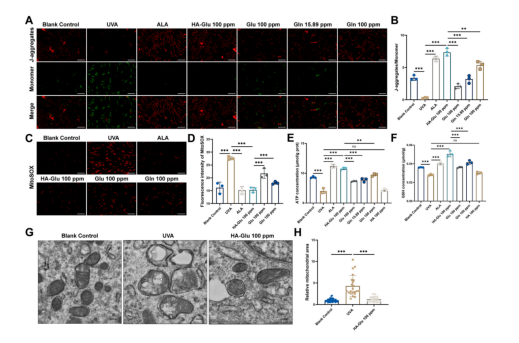


图2 HA-Glu改善UVA应激成纤维细胞的线粒体功能(论文Fig. 2)
图3 SLC1A3抑制条件下HA-Glu维持低衰老表型与细胞外基质输出(论文Fig. 3)
图4 HA-Glu改善UVB诱导的光老化小鼠皮肤结构与炎症信号(论文Fig. 4)
DOI:10.3390/cosmetics13060287